
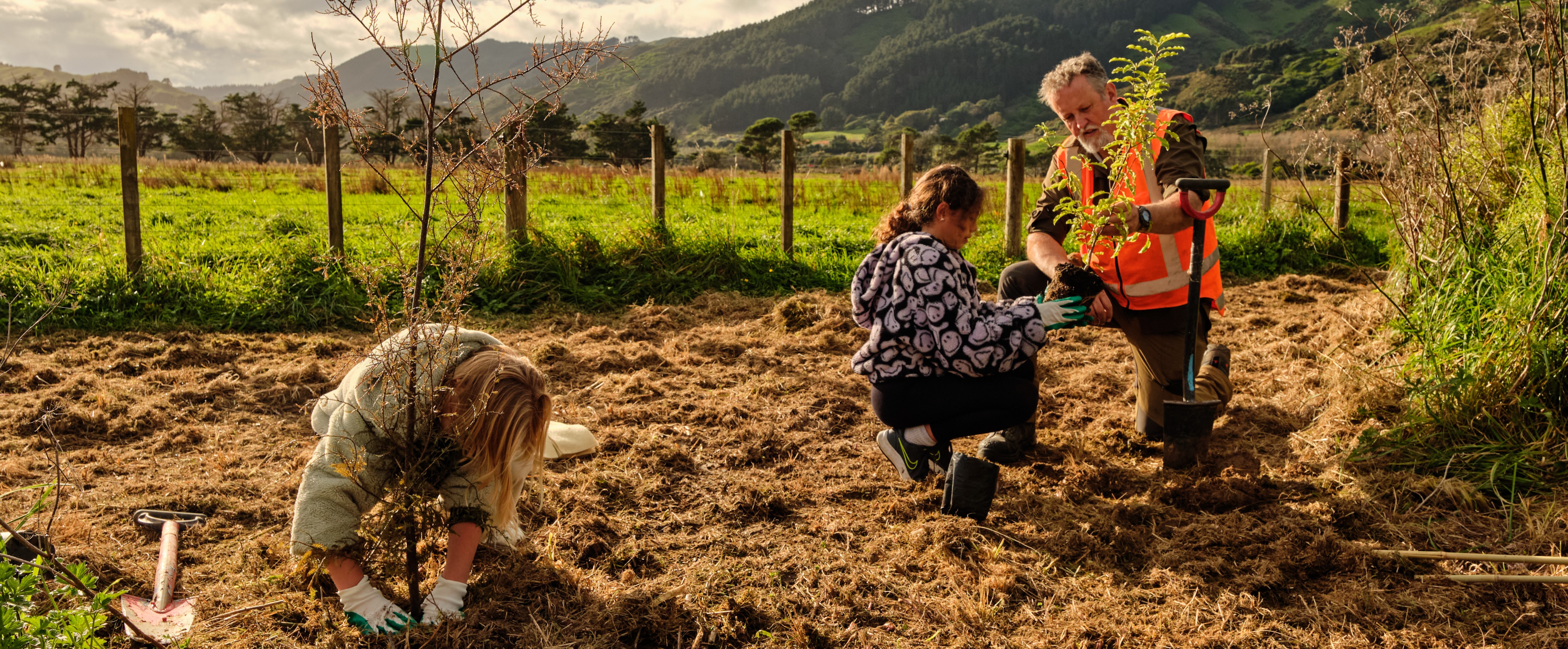
One million trees in our regional parks
Greater Wellington runs one of the largest native tree planting programmes in Aotearoa New Zealand. Our vision is to restore healthy native ecosystems by transforming formerly grazed land in regional parks back into thriving ngahere (forest). There is also extensive pest management, scientific monitoring, and community work undertaken to protect and restore healthy ecosystems in parks.
We plant around 200,000 native plants each year, working steadily towards large-scale restoration across our parks. Over time, this work adds up to significant change – with one million natives planted across extensive areas of parkland, and many more to come.
Native planting takes time to establish, but the benefits grow year by year – supporting our forests, wildlife, freshwater, climate, and creating better places for everyone to enjoy.
Recloaking Papatūānuku (recloaking Mother Earth)
Park ecosystems are in different states of health. A significant programme called Recloaking Papatūānuku, or the Parks Restoration Programme, is focused on restoring the formerly grazed areas of parks which are in the poorest states of health. Recloaking Papatūānuku includes restoration plantings in Queen Elizabeth Park, Belmont, Kaitoke, Battle Hill and Baring Head/Ōrua-pouanui (East Harbour Regional Park).
This mahi (work) is a collective effort. We partner with mana whenua and community nurseries to grow locally sourced plants, and with local contractors and community groups who help get them into the ground each winter.
In the winter of 2026, Greater Wellington will have planted over one million native plants across nearly 500 hectares of formerly grazed areas in the regional parks. We will continue planting at a rate of about 50-70 hectares, and 200,000 native plants per year.
The restoration programme is not just about planting trees; we aim to restore whole ecosystems. Most of the region’s bushland has regenerated through natural processes. The restoration programme is supporting natural processes of regeneration with extensive pest plant and animal management work. Fire threat management plans, new fire break trails and removal of redundant fencing are also included.
We’ve also worked on wetland restoration in Queen Elizabeth Park, through the construction of weirs to block drainage channels and improve fish passage. This allows previously drained land to return to natural wetlands.
The programme has been funded initially through Greater Wellington's Low Carbon Acceleration Fund (LCAF) and then the Long-Term Plan. The LCAF was established in 2020 by borrowing against a free allocation of carbon credits received for pre-existing forests on Greater Wellington land.
The benefits of restoration
Through stock retirements and licence variations, overall emissions attributed to grazing in regional parks have almost halved (reduced by 49% from 2018/19 to 2026). This reduction is making a significant contribution towards helping Greater Wellington meet our carbon reduction goals.
Restoring parkland previously grazed by stock increases the health and quality of freshwater streams, wetlands, rivers and inlets. A lack of vegetation, particularly streamside (riparian) reduces fish spawning habitat and causes streambank erosion. Riparian planting is an effective method to mitigate sediment, pathogens, and excess nutrients.
Farming activities increase the sediment load in water catchments, especially on steeper slopes. Stock access to waterways and overland water flow through grazed paddocks is one of the main routes for E. coli (from stock dung) to enter waterways. Macroalgae blooms can also occur when there is excess phosphorus and nitrogen (from fertiliser or dung) in waterways. These have a range of adverse effects like reducing light for desirable species, smothering shellfish beds, and depleting oxygen.
Recloaking Papatūānuku is deeply interrelated with other programmes of work related to freshwater and biodiversity.
Restoration challenges and resources
Managing pest plant, animal and fire threats is a core part of the parks restoration programme. Threat management for pest plants and animals is broadly addressed in He Aratohu Whakahauman Papa | Regional Parks Restoration Guide. There are also practical guides to restoration and planting available for community groups.
He Aratohu Whakahauman Papa | Regional Parks Restoration Guide
The purpose of the Recloaking Papatūānuku Restoration Guide (referred to hereafter as Restoration Guide) is to guide the phased retirement of grazed land in Greater Wellington’s regional parks and to… Read more here
date_range Published 20 Jun 2023
Download now (PDF 23 MB) get_appRestoration Planting: A guide to planning restoration planting projects in the Wellington region
Practical advice on planning and running biodiversity restoration projects, including site preparation and maintenance, pest control and planting. Read more here
date_range Published 31 May 2014
Download now (PDF 2.2 MB) get_appGet in touch
- Phone:
- 0800 496 734
- Email:
- info@gw.govt.nz